How many lions live in Kruger? How many elephants, leopards or rhinos? Search online and you will find wildly different answers, often copied from figures that are ten or fifteen years old. This guide collects the best available estimates for Kruger's key species, tells you where each number comes from and how old it is, and explains how scientists actually count animals in a park of almost two million hectares. You will also see why every number is an estimate with a range, and what the figures mean for what you can expect to see on your drive.
Kruger by the Numbers: Summary Table
Every figure below is an estimate from a survey, not an exact headcount. Always look at the year, because some species have not had a park-wide count for a long time.
| Species | Best available estimate | Year and source basis | Trend |
|---|---|---|---|
| Elephant | about 39,000 (range about 35,500 to 43,300) | 2025 SANParks sample survey, as reported in 2026 | Growing, about 5% a year from 2013 to 2020 |
| Buffalo | roughly 37,000 to 47,000 | SANParks estimates, 2010/11 and 2016 | Dropped in the 2015/16 drought, increasing again (2023 survey) |
| Lion | about 1,076 older than one year (range 808 to 1,343) | Surveys 2023 to 2025, reply to Parliament, 2026 | Not directly comparable with earlier counts, clear decline in the north since 2005 |
| Leopard | about 1,000 | Long-standing SANParks estimate (2010/11) | No recent park-wide count published |
| White rhino | about 1,850 | End of 2022, SANParks Annual Report 2022/23 | Down from about 10,600 in 2011 |
| Black rhino | about 210 | End of 2022, SANParks Annual Report 2022/23 | About half of the 2013 figure (415) |
| Wild dog | about 250 to 350 | EWT figures, 2022 and later | Up from a low of about 120 (2009) |
| Cheetah | about 116 | 2021/22 photographic census (EWT and SANParks) | Unclear, methods and effort changed |
| Spotted hyena | about 7,300 (range 6,998 to 7,680) | 2015 call-up survey | Increased since 2005 |
| Giraffe | roughly 6,800 to 10,300 | SANParks estimate, 2010/11 | Increasing since the 1990s (2023 survey) |
| Hippo | about 7,300 to 7,500 | 2015 count and 2016 SANParks figure | Dipped in the 2015/16 drought, recovering |
| Nile crocodile | about 4,400 | SANParks estimate, 2010/11 | Decreasing since the late 1990s |
| Impala | roughly 132,000 to 176,000 | SANParks estimate, 2010/11 | Stable over the past 10 years (2023 survey) |
| Zebra | roughly 23,700 to 35,300 | SANParks estimate, 2010/11 | Increasing (2023 survey) |
SANParks counted the large mammals and crocodiles again in 2023, across 19,194 km² of the park. It published the trends from that survey in 2025, which is why the trend column is often newer than the number next to it.
Total Species: More Than the Big 5
SANParks lists 147 mammal species (its wildlife checklist counts 148), 507 bird species, 114 reptiles, 34 amphibians, 49 fish and 336 tree species.
Elephants: The Number That Keeps Rising
Elephants are the clearest growth story in Kruger. Until the mid-1990s, SANParks culled elephants to keep their numbers down. Culling has mostly stopped since then, and the population has grown steadily.
A 2024 study by SANParks scientists estimated 31,324 elephants in 2020 (range 28,457 to 34,191), growing at about 5.3% a year since 2013. The study also found that counts which do not correct for missed animals underestimated elephant numbers by roughly 15% in 2020, because observers in aircraft miss animals. According to SANParks' 2025 sample surveys, as reported by Africa Geographic in 2026, the population now stands at about 39,390 (35,468 to 43,312). SANParks scientists themselves have written that Kruger held between 28,000 and 39,000 elephants over the six years from 2020.
This is also a good example of outdated figures: SANParks' own mammal page still quotes an older figure of 17,000 elephants, and many travel sites copy it.
For you, the result is simple. With tens of thousands of elephants spread across the park, you will very likely see them every day. Our guide to understanding elephant behaviour helps you read what they are telling you.
Lions: New Methods, Lower Numbers
For years, the standard answer to "how many lions are in Kruger" was about 1,600 to 1,750, the range in SANParks' 2010/11 statistics. According to the environment minister, park-wide surveys estimated 1,684 lions of all ages in 2005/06 and 1,803 in 2015.
The latest park-wide estimate comes from surveys between 2023 and 2025 by the Endangered Wildlife Trust (EWT), Nelson Mandela University and SANParks. In a 2026 reply to Parliament, the environment minister gave 1,076 lions older than one year, with a confidence range of 808 to 1,343. That includes about 294 adult males, 523 adult females and 259 subadults. Cubs under one year are not included, so the figure is not directly comparable with the older "all ages" counts. (A later reply quoted 1,343, the top of that range.)
The clearest decline is in the north. EWT surveys estimated about 105 lions in the Nxanatseni North region in 2023 and about 144 in Nxanatseni South in 2024, a density of about 3.5 lions per 100 km². In the north, a 2005 call-up survey had estimated 283 lions, although a 2015 repeat survey already found only about 119. The EWT points to snaring, poisoning and poaching as likely pressures. If you want to understand what you are watching at a lion sighting, read reading lion behaviour safely.
Leopards: The Hardest Cat to Count
How many leopards live in Kruger? The figure SANParks has used for years is about 1,000. It appears in the park's 2010/11 statistics and on its current mammal page. No newer park-wide leopard estimate has been published.
Leopards are solitary, mostly nocturnal and well camouflaged, which makes them hard to count from the air. Researchers use camera traps instead and identify individuals by their unique rosette patterns, but these studies cover sample areas, not the whole park. Treat "about 1,000" as an order of magnitude, not a precise count. Our leopard spotting guide covers where and when to look.
Rhinos: Numbers Under Pressure
Rhino figures need extra care. Kruger was once a global rhino stronghold: in 2011 the park held an estimated 10,621 white rhinos, and in 2013 about 415 black rhinos. Poaching changed that dramatically.
By the end of 2022, the SANParks Annual Report 2022/23 put Kruger's rhinos at about 1,850 white and 210 black rhinos, a total of about 2,060. That is a decline of around 78% in total rhino numbers since 2013. Not every annual report publishes rhino estimates: the 2021/22 report gave none for either species. Poaching continues. Kruger lost 88 rhinos to poachers in 2024 and 175 in 2025, according to the environment department, even as national poaching fell by 16%.
We do not publish rhino locations, and we ask you not to share them either. Read why we ended live sightings and our guide to the ethics of sharing sightings.
Wild Dogs and Cheetahs: Counted by Visitors
Wild dogs and cheetahs are rare and range over huge areas, so Kruger counts them with the help of visitors. Since 1988/89 for wild dogs, and since 1990 for cheetahs, photographic censuses have been run every few years, today by the EWT and SANParks. Visitors and guides submit photos, and researchers identify each animal by its coat pattern, which is as unique as a fingerprint.
Wild dogs: the EWT records about 400 wild dogs in 1995, a low of about 120 in 2009 and about 250 in 2022, and now speaks of around 350 in the park. The trend since the 2009 low is upward.
Cheetahs: the 2021/22 census received 196 submissions, identified 86 individual cheetahs and estimated about 116 cheetahs in the park. The EWT stresses that this is not proof of a collapse, because fewer tourists during COVID-19 and a new AI-assisted identification method affected the result. For comparison, a modelling study of the 2008/09 census estimated about 412 cheetahs. Different methods give very different numbers.
You can take part: the Greater Kruger Cheetah Census runs from 1 September 2026 to 31 August 2027. Photograph both sides of the cheetah from a respectful distance and submit the photos with the date and location through the EWT's census page. Send them to the researchers rather than posting live locations on social media. For more on these predators, read hyenas and wild dogs at waterholes.
Hyenas, Hippos, Crocodiles and the Plains Game
Spotted hyenas are far more common than most visitors realise. A 2015 call-up survey estimated about 7,339 (6,998 to 7,680), roughly double the 2005/06 estimate, which researchers link to more prey.
Hippos numbered about 7,270 in 2015, and SANParks gave about 7,500 in 2016, during the drought. Numbers dropped during the 2015/16 drought and are recovering. Crocodiles were estimated at about 4,420 in 2010/11, and SANParks reports a decline since the late 1990s linked to changes in the rivers that affected their diet.
Impala are the most numerous large mammal, with a 2010/11 estimate of 132,300 to 176,400, and SANParks says numbers have been stable for the past decade. Zebra (23,700 to 35,300 in 2010/11) and giraffe (6,800 to 10,300) are both increasing according to the 2023 survey.
How Kruger Counts Its Animals
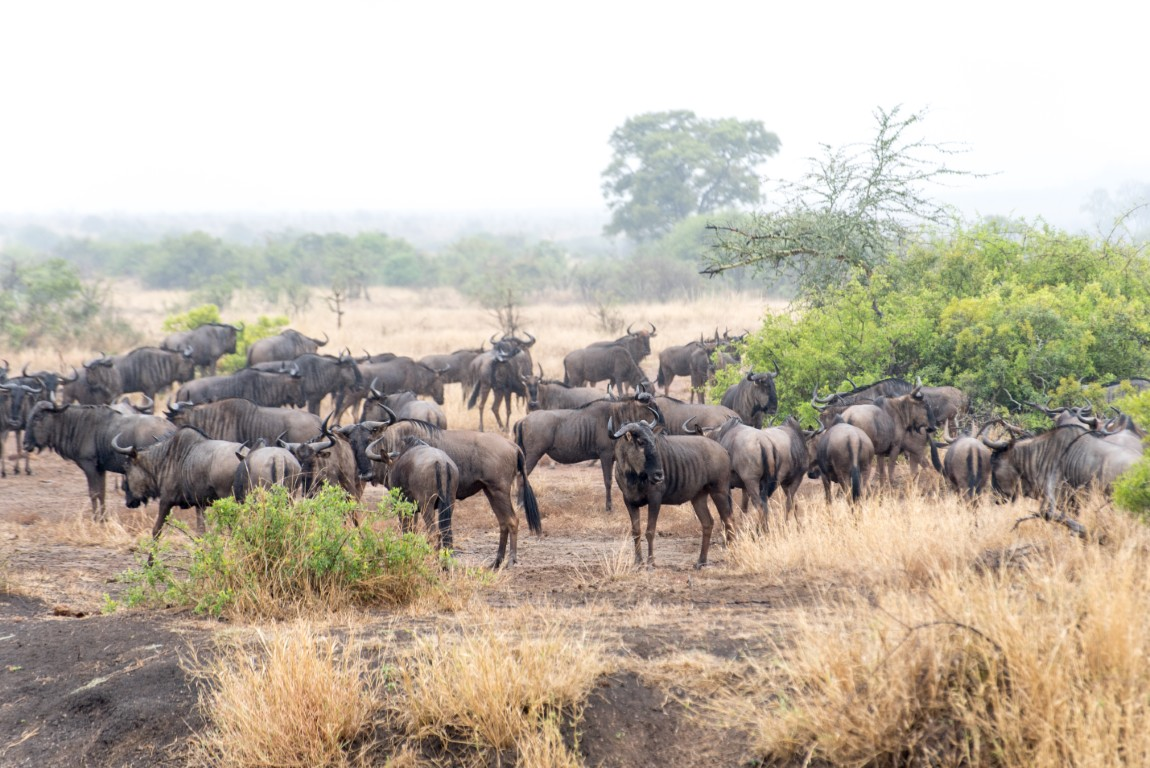
Fixed-wing aircraft count impala, zebra, kudu, giraffe and wildebeest. A small plane flies straight lines across the park while observers count animals in marked strips beside the aircraft. Statistical models then correct for missed animals and scale the count up to the whole park.
Helicopters count elephant, buffalo, rhino and rare antelope such as sable and roan. They fly lower and slower and can hover over large herds. Rhinos and elephants are counted in sample blocks, not in a full sweep of the park, and the result is corrected for animals the observers did not see.
River surveys, also by helicopter, count hippos and crocodiles along rivers and dams.
Call-up stations were long used for lions and hyenas. Researchers play recorded sounds, such as a buffalo in distress, through loudspeakers at sites several kilometres apart and count the predators that arrive. The method is vulnerable to weather and double counting.
Photo identification and camera traps are now the main tools for big cats. Lions are identified by their whisker spots, the unique pattern of spots at the base of their whiskers. In 2024 the EWT team drove 10,446 km along set routes. Spatial capture-recapture models then estimate how many lions were never photographed.
That last point explains why big cat numbers always come with a range. You cannot see every animal, so you model the ones you missed. A wider range means more uncertainty, not a mistake.
What the Numbers Mean for Your Safari
The numbers explain what you see. With tens of thousands of elephants, buffalo, zebra and impala, you will see these animals almost every day. With around a hundred cheetahs and a few hundred wild dogs across a park of almost 20,000 km², a sighting is a matter of luck.
Location matters too. Census studies have found most wild dogs and cheetahs in the south and central regions, with few in the far north, and lion numbers in the north are now low. If predators are your priority, the south and central regions give you better odds. Our guide to north vs south Kruger compares the two halves, and the Big 5 guide covers where to look for each species.
Frequently Asked Questions
How many lions are there in Kruger National Park? The latest park-wide estimate, from surveys between 2023 and 2025, is about 1,076 lions older than one year, with a range of 808 to 1,343. Cubs are not included. According to the environment minister, earlier surveys estimated 1,684 (2005/06) and 1,803 (2015) lions of all ages.
How many leopards live in Kruger? SANParks has long estimated about 1,000 leopards. That figure dates from 2010/11, and no newer park-wide count has been published, so treat it as a rough guide.
How many elephants are in Kruger? About 39,000 according to the 2025 SANParks sample survey, up from about 31,000 in 2020. The often-quoted figures of 13,000 to 17,000 are outdated.
Why are current rhino numbers hard to find? SANParks has not published estimates every year. The latest published figures are for the end of 2022: about 1,850 white and 210 black rhinos. Poaching remains the main threat, which is why you should never share rhino locations.
Can I help count Kruger's animals? Yes. The Greater Kruger Cheetah Census runs from September 2026 to August 2027. Photograph both sides of any cheetah you see and submit the images, date and location to the Endangered Wildlife Trust.