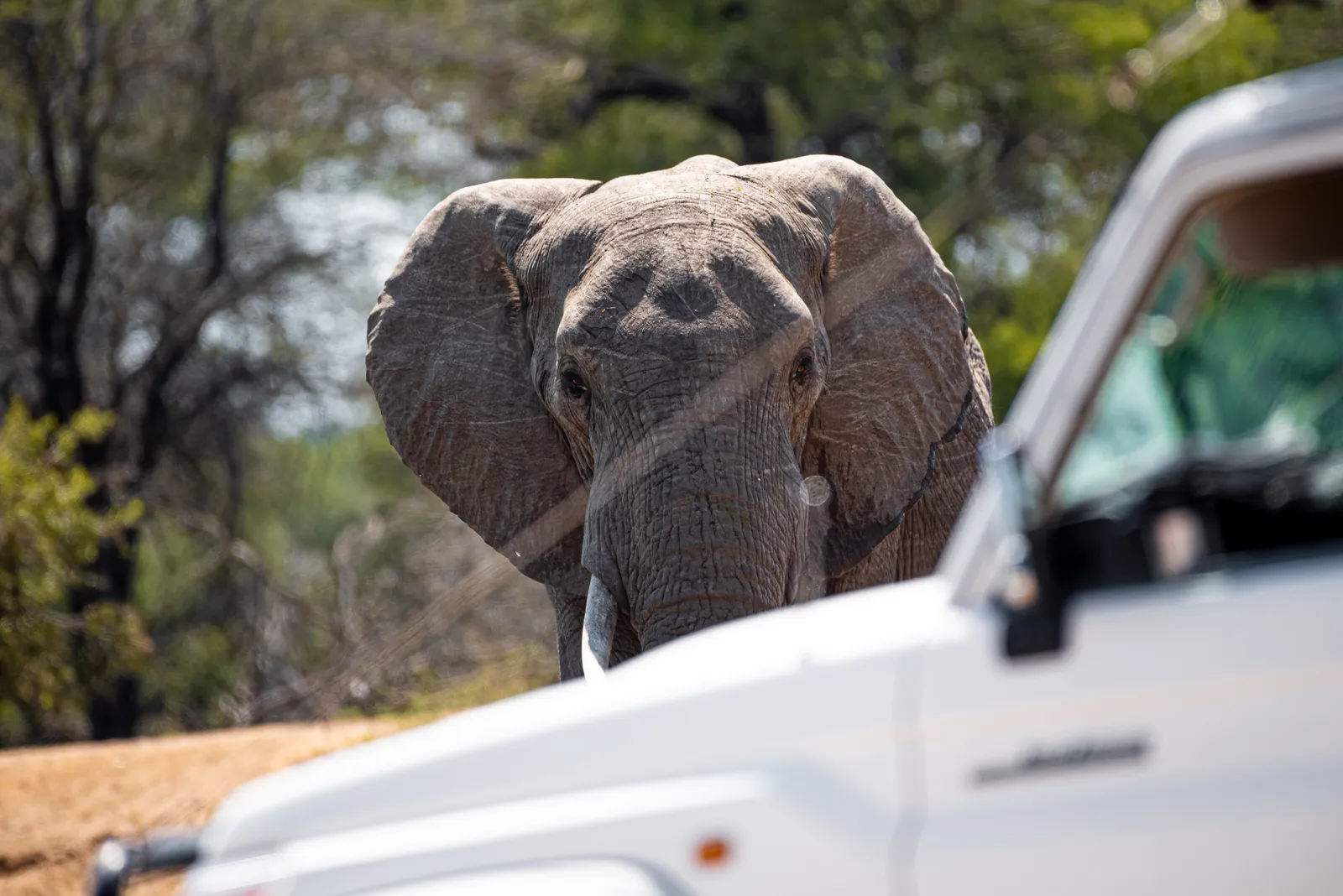
Short answer: no. Kruger's public tourist roads, tar and gravel alike, are maintained for ordinary cars, and most self-drive visitors explore the park in a normal sedan or a compact SUV. A higher vehicle makes game viewing easier and gravel more comfortable, but a true 4×4 only matters for the bookable SANParks 4×4 trails, the Giriyondo border crossing or unusually wet conditions in the remote north.
What Kruger's roads are actually like
Kruger has two kinds of tourist roads. The main arteries, marked H on the park map (for example the H1 that links the big camps), are mostly tarred. The secondary roads, marked S, are mostly gravel. A University of Pretoria study (Malherbe, 2020) puts the public road network at about 2,294 km, of which roughly 850 km is tarred and 1,444 km is dirt. In other words, around two thirds of what you can drive is gravel, which is exactly why the question of the right car comes up so often. If the letters and numbers on the signs are new to you, see our guide to Kruger road signs and map codes.
None of this is off-roading. SANParks sets the speed limit at 50 km/h on tar and 40 km/h on gravel, and driving off the road or onto any road with a "no entry" sign is not allowed. Those no-entry tracks are management and service roads, closed to visitors whatever you drive. So the only roads you will use are the ones SANParks maintains for regular visitor traffic.
What a normal sedan handles fine
In the dry season, a standard rental hatchback or sedan copes with practically the whole tourist network. The tar roads feel like a quiet country road, only slower. The gravel roads are graded regularly, and our guide to navigating Kruger's dirt roads explains why the vast majority of them are perfectly fine for a normal car in dry weather.
What a sedan driver notices is comfort and caution rather than capability. Busy gravel stretches can develop corrugations (a washboard surface) that make a small car rattle; slowing down or finding the speed at which the car rides most smoothly helps. Low ground clearance means watching for the occasional rock, rut or eroded edge, and taking dips and drainage humps slowly. Dust is the other everyday factor: hang back from the car in front and close your windows when someone passes.
Where ground clearance genuinely helps
A higher vehicle earns its keep in a few specific situations.
Corrugated and rutted gravel. An SUV or crossover with more suspension travel absorbs washboard surfaces far better and is less likely to scrape on a rough patch. Over a long gravel loop, that difference in comfort adds up.
The rainy season. Kruger's rain falls mainly in summer, roughly November to March. Heavy storms can soften gravel roads, leave deep puddles and wash out sections. SANParks closes affected roads, sometimes for days, and posts the closures on boards at gates and camps. Extra clearance gives you more margin on a muddy road that is still open; it does not make a closed road open.
Low-water crossings and causeways. Several roads cross rivers on low-level bridges or drifts. After heavy rain these can flood and be closed. Never try to drive through flowing water in any vehicle: depth and current are impossible to judge, and crocodiles and hippos live in those rivers.
The remote far north. Around Pafuri, roads can be rough after rain, and a high-clearance vehicle is advisable on the sandier tracks of the north in summer. For the Giriyondo border crossing into Mozambique's Limpopo National Park, a 4×4 is recommended. See Getting to Kruger for border details.
When you really do need a 4×4
The one situation where a proper 4×4 is non-negotiable is driving the SANParks 4×4 trails. These are separate, controlled routes, not part of the normal road network, and you cannot simply turn onto them.
The only self-drive 4×4 adventure trail still offered is Mananga near Satara, a day route of about 48 km. You arrange it at Satara reception on the day, a maximum of six vehicles may use it per day and it closes after rain. Vehicles must be self-sufficient, as there are no facilities along the way. Older guides also list Madlabantu, Nonokani and Northern Plains, but SANParks no longer offers them.
The multi-day 4×4 eco trails, such as the Lebombo overland trail along the park's eastern boundary or the Mafunyane trail in the north-west, are guided, run on set dates and must be booked in advance through SANParks reservations. Trail details, prices and vehicle requirements change, so confirm the current conditions with SANParks before you plan around them.
If none of this is on your list, you do not need four-wheel drive.
The real advantage of a higher vehicle: seeing more
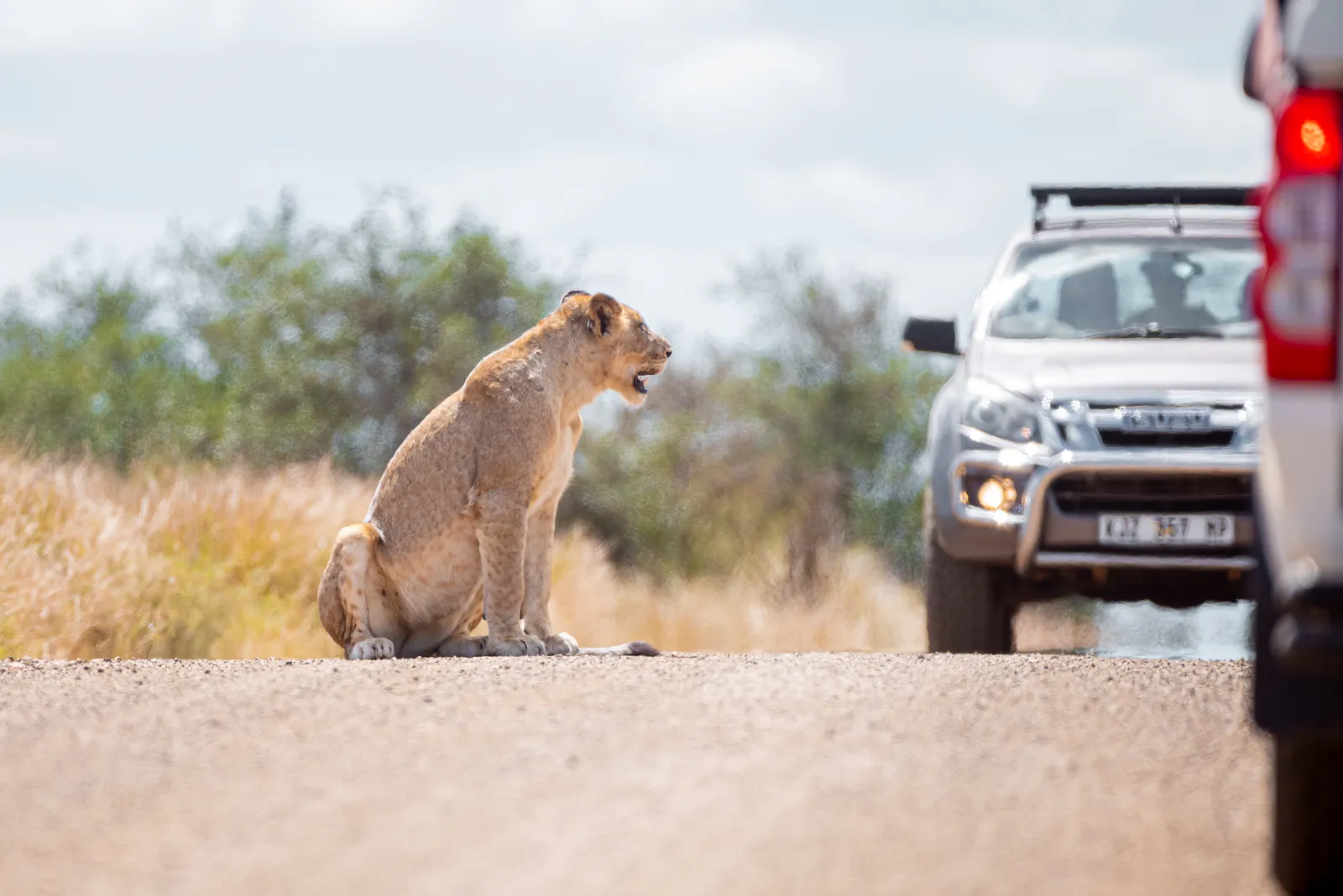
Ask experienced Kruger self-drivers why they choose an SUV and the answer is usually viewing height, not drivetrain. In a low sedan, roadside grass and bushes block much of your view, particularly late in the rainy season when the grass stands tall. Sitting higher lets you look over that vegetation, pick out a lion lying in the grass or a leopard's tail hanging from a branch, and see further across open plains. It also helps when several cars are gathered at a sighting.
Comfort is the second reason. Kruger days are long: many visitors are on the road from gate opening until shortly before gate closing, much of it at 20 to 40 km/h. A vehicle with a softer ride, good air conditioning and easy access for children or older passengers makes those hours far more pleasant. That is why plenty of visitors rent an SUV and never once engage four-wheel drive.
Sedan vs SUV vs 4×4 at a glance
| Vehicle | Good for | Limitations |
|---|---|---|
| Sedan / hatchback | Tar and dry-season gravel; budget trips | Low seat blocks views over grass; rattles on corrugations; less margin on rough patches |
| Compact or mid-size SUV / crossover | Most first-time visitors; the best all-round choice | Costs more to rent; still no access to 4×4 trails |
| True 4×4 (high clearance, low range) | SANParks 4×4 trails; Giriyondo crossing; wet-season far north | Most expensive; more than you need on the normal road network |
Wet season vs dry season
In the dry season (roughly April to October), roads are at their most predictable. Gravel is firm, closures are uncommon and a sedan works almost everywhere. The main nuisances are dust and corrugations on busy gravel roads. The bush is also thinner, so the viewing-height advantage of an SUV is smaller.
In the wet season (roughly November to March), the picture changes. Storms can close gravel roads and causeways at short notice, the grass grows tall and animals are harder to spot from a low seat. You can still have an excellent trip in a sedan, but plan around the tar network, check the road-closure boards each morning and treat gravel loops as a bonus. Our article on weather and animal behaviour covers what each season means for wildlife.
Renting a car for Kruger: practical checks
Most international visitors rent a car either at OR Tambo International Airport in Johannesburg, followed by the drive described in our Johannesburg to Kruger N4 road trip, or at Kruger Mpumalanga International Airport (KMIA) near Mbombela, about an hour's drive from the nearest gates. Book early for June to September and December, when demand peaks. If you want to compare rental cars, you will find a car hire partner on our partners page.
Before you sign, check a few things:
- Gravel roads in the contract. Check whether your rental agreement and insurance cover driving on gravel roads, and whether any exclusions apply. With about two thirds of Kruger's network on gravel, this matters.
- Tyres and windscreen. Find out whether tyre, rim and windscreen damage is included in your cover or needs an add-on, as stone chips and punctures are the most likely damage on gravel.
- Spare wheel and tools. Make sure the car has a usable spare wheel rather than only a repair kit, plus a working jack and wheel spanner, and that you know where they are. In most of the park you may only get out of your car at designated spots, so careful driving beats relying on a roadside repair.
- Vehicle category. If you want the viewing height, book an SUV or crossover class explicitly, so you are not handed a sedan "or similar".
Which car should you choose?
- First visit, dry season, mainly southern and central Kruger: a sedan is fine; a compact SUV is better for viewing.
- Travelling in the wet season or with children: choose an SUV or crossover for height, comfort and extra margin on rough gravel.
- Planning lots of gravel loops or the remote north: a high-clearance SUV, and in summer consider a 4×4.
- Booking a SANParks 4×4 trail or crossing at Giriyondo: you need a proper 4×4.
- Not keen on driving at all: compare the options in self-drive vs guided safaris.
Whatever you drive, the bigger factors are the same: be back in camp before the gates close, drive slowly enough to spot wildlife, and carry offline maps, because mobile signal drops quickly outside camps. The Kruger Companion app works offline across the whole road network.
FAQ
Can I drive the gravel roads in Kruger with a normal rental car? Yes. In dry conditions, the gravel tourist roads are suitable for ordinary cars. Drive slowly, watch for rocks and ruts, and check that your rental contract covers gravel roads.
Do I need a 4×4 in the rainy season? Not for the open tourist roads. SANParks closes gravel roads and causeways that become unsafe, so what you need is to respect the closures and lean more on the tar network. A higher vehicle does give you more margin on muddy roads that remain open.
Can I drive off-road in Kruger with a 4×4? No. Off-road driving and roads marked "no entry" are prohibited for every vehicle. The only 4×4 driving beyond the normal roads is on the SANParks 4×4 trails, which have to be booked.
Is an SUV worth the extra cost? For most visitors, yes, mainly for the higher seating position, which makes spotting animals in grass and bush much easier, and for comfort on corrugated gravel.