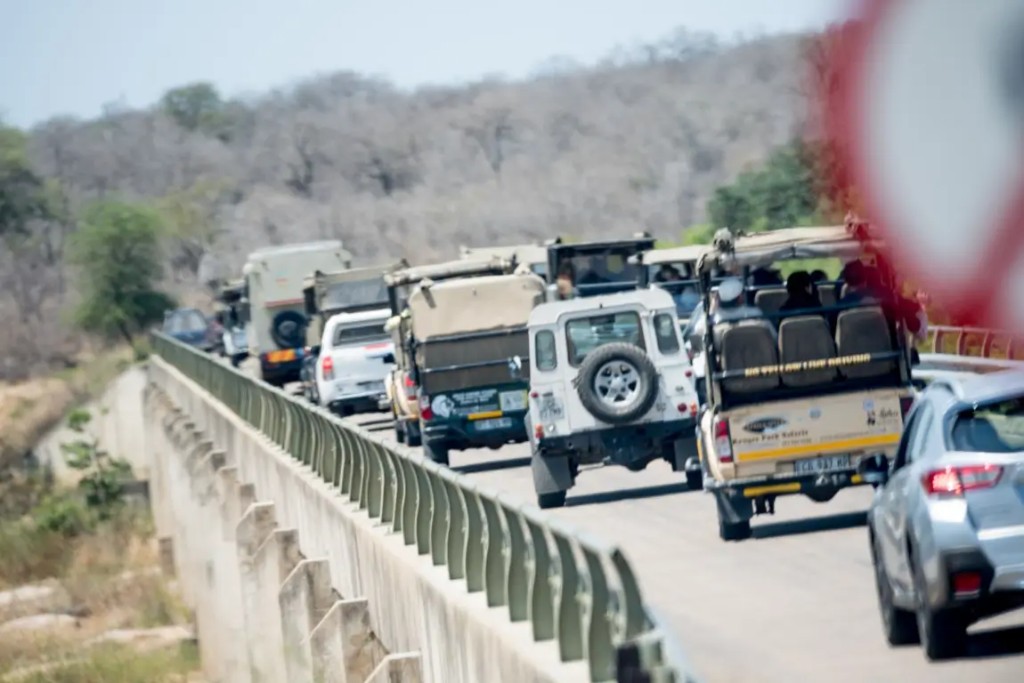
Sighting Traffic Etiquette: Park on the Side and Keep Kruger Moving
Few things frustrate Kruger visitors more than a sighting traffic jam—a long line of stationary vehicles blocking both lanes while a lion sleeps in the shade, oblivious to the chaos behind it. The good news is that most jams are preventable. One simple, widely respected rule solves the majority of problems: park on the side of the sighting and keep the other lane free.
This is not just good manners. It keeps roads passable for emergency vehicles, reduces stress on wildlife, and makes the experience better for everyone who arrives after you.
What "Park on the Side of the Sighting" Actually Means
Kruger's public roads are narrow. On many stretches there is effectively one usable lane in each direction, with soft shoulders and thick bush right up to the edge of the tar or gravel.
When you stop for wildlife, position your vehicle on the same side of the road as the animal—as far to the edge as you safely can—so that the opposite side of the road remains clear for traffic to pass.
Example: A leopard is lying in the grass on the right side of the road. Pull over to the right, tuck in close to the verge, and leave the left side open. Drivers coming from behind can pass on the left without stopping, and oncoming traffic (where the road allows) is not boxed in.
The goal is never to "claim" the entire road for your sighting. You are sharing a working transport network inside a national park, not a private game-drive loop.
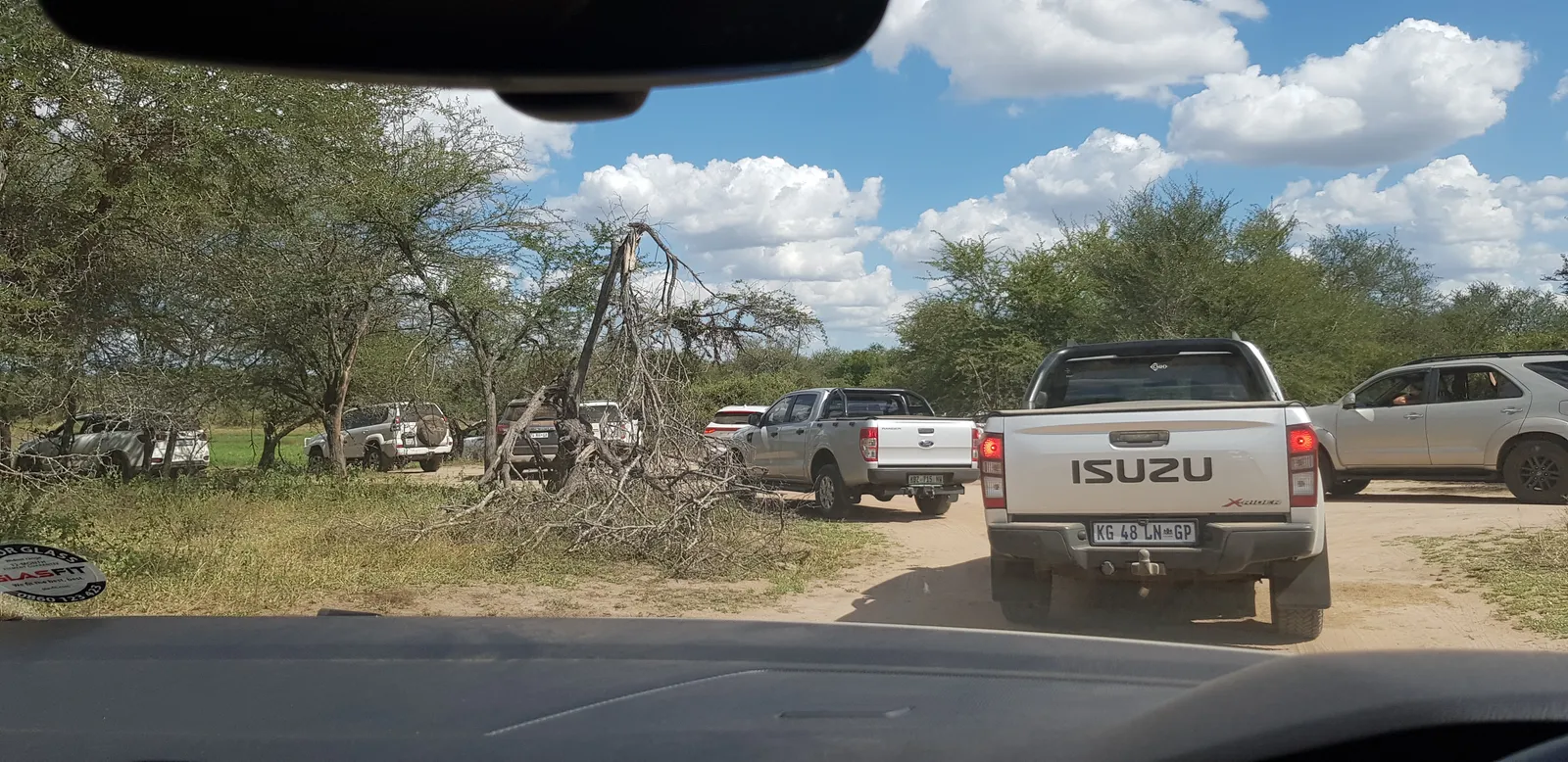
Why This Rule Matters
1. Emergency access
Rangers, veterinary teams, and medical responders use the same roads you do. A blocked road at a popular sighting can delay a response when minutes matter—for a snakebite at a picnic site, a vehicle breakdown in heat, or a wildlife emergency.
2. Animal welfare
When vehicles surround an animal on both sides of the road, it can feel trapped. Elephants may flare their ears or mock-charge. Predators abandon a kill. Nervous antelope bolt into traffic. Giving animals space—and keeping one lane moving—reduces the pressure of a "vehicle wall."
3. Everyone's experience
The person behind you may be rushing to make gate closing time. Another visitor may have driven two hours for their first lion sighting. A clear passing lane means people can choose to stop—or move on—without confrontation.
4. Safety
Blocked roads encourage risky behaviour: reversing around blind corners, overtaking on soft shoulders, or drivers standing up through sunroofs to see past the queue. A passable lane is a safer lane.
How to Park Correctly at a Sighting
Follow this checklist every time you stop:
- Signal early — Indicate and slow down gradually. Sudden stops cause rear-end near-misses on dusty gravel roads.
- Read the animal's position — Identify which side of the road the sighting is on before you commit to a parking spot.
- Pull to the verge on that side — Get as far off the driving line as the surface allows without dropping into a ditch or crushing vegetation off-road (stay on the designated road surface).
- Angle slightly if helpful — A gentle angle toward the animal can improve visibility for your passengers without swinging your rear end across the lane.
- Kill the engine when appropriate — At longer stops, switch off to cut noise and fumes. Be ready to move if the animal approaches or traffic needs to flow.
- Leave a gap — Do not tuck bumper-to-bumper unless the sighting is enormous and everyone is clearly parked in a single line on one side. A small gap makes it easier for the queue to dissolve when someone moves off.
On gravel roads, shoulders are often softer. If you cannot pull fully clear without sinking, take the safest position you can, keep your stop brief, and be prepared to move on so the road does not choke up.
The Most Common Mistakes
Blocking both lanes
This is the classic jam. Two or three vehicles stop in the centre of the road, doors open, cameras out, and within minutes both directions are frozen. Even if the sighting is incredible, never block the only escape route for other traffic.
"Centre parking" for a better photo
It is tempting to stop in the middle for a symmetrical shot. Don't. Take your photo from the side, use a longer lens, or accept that ethical fieldcraft beats a perfect composition.
Stopping on a blind rise or corner
If you cannot see far enough ahead for others to pass safely, drive past, find a straight section, and walk back on foot—no, wait: you cannot get out. Drive to a safer pull-off further along, or skip it. Stopping on a blind corner creates serious collision risk.
Adding to an already blocked scene
If you arrive and both lanes are already full, do not squeeze in. Either wait at a distance until space opens, or drive on. Piling in makes the jam worse and tensions rise fast.
Standing up, sitting on windowsills, or leaning out
Park rules require you to remain inside the vehicle. At congested sightings, people standing on seats block the view for everyone behind them and encourage others to do the same. Stay seated unless you are in a sanctioned open safari vehicle on a guided drive.
How to Prevent Traffic Jams Before They Start
Prevention is easier than untangling a fifteen-car knot around a sleeping buffalo.
Arrive with a "move on" mindset
Not every sighting needs twenty minutes. If you have had a good look and taken your photos, release the spot. The Kruger rhythm rewards drivers who keep exploring—often the next corner is better.
Limit your stop at crowded cats
Lions and leopards attract crowds fast. Enjoy the moment, then go. If you want extended predator time, plan dawn drives on quieter S-roads where you are less likely to be part of a mob scene.
Use pull-offs and loops wisely
At waterholes and bridges, use designated widening areas where they exist. If the layout naturally funnels traffic, stop only if you can do so without sealing the funnel.
Communicate calmly
A friendly hand gesture—"go ahead" or "we're leaving"—helps the line flow. Horn use and shouting make things worse. Kruger is not a city commute.
Share the sighting
If your vehicle has the best angle, rotate after a few minutes. Others have travelled just as far as you have.
What to Do When You Arrive at a Busy Sighting
- Assess from a distance — Can you see a clear lane? If not, slow down but keep moving.
- Join the correct side — Never cross into oncoming position just to see better.
- Be patient or pass — Waiting fifty metres back is fine. So is deciding the jam is not worth it.
- Watch for reverse lights — Someone may be trying to exit. Make space.
- Move when the animal moves — If wildlife crosses the road, hold back until it is safe and the road clears. Do not chase or race ahead for position.
Safari Vehicles vs Self-Drive
Open safari vehicles from lodges often stop in ways that look informal but are guided by experience and radio networks. As a self-driver, you are still bound by the same road rules: do not block traffic, stay in your vehicle, and respect speed limits.
If a guided vehicle is stopped ahead of you, treat it like any other queue—pass only when it is safe and a lane is genuinely free.
When You Should Leave Immediately
Move on without debate if:
- Traffic is building behind you and you are in the travel lane
- An elephant, buffalo, or predator is showing stress or aggression
- Rangers ask vehicles to clear the area
- You are on a main tar artery during peak hours (school holidays, long weekends)
- Visibility is poor and your stop creates a hazard
A five-star sighting that causes a jam is remembered for the wrong reasons.
A Simple Rule to Remember
Same side as the animal. Other lane stays open. Short stop, then roll.
That one habit—taught informally by rangers, repeated on forums, and listed on Kruger etiquette pages—does more for park harmony than almost any other self-drive tip. Pair it with low speed, patience, and respect for gate times, and you contribute to the kind of safari Kruger was designed for: wild, shared, and safe.
Quick Reference
| Situation | What to do |
|---|---|
| Animal on right side of road | Park right, keep left lane clear |
| Animal on left side of road | Park left, keep right lane clear |
| Animal in the middle of the road | Hold back at a safe distance; do not box it in |
| Road already blocked | Do not add to the queue; wait back or drive on |
| You have had a good view | Move off within a few minutes |
| Emergency or ranger vehicle | Pull aside immediately and create space |
For the full list of driving and wildlife rules in the park, see our Kruger Rules & Etiquette page—and use the Kruger Companion app to find quieter routes when the main roads turn into sightseeing car parks.
Real-World Scenarios
A lion on the tar road near Satara
Satara's open grasslands make lion sightings common—and congestion almost inevitable on the H1-3 and connecting roads. If the pride is on the left verge, every stopped vehicle should be on the left. Resist the urge to stop in the right-hand lane "just for a quick photo." Within minutes, both directions seize up and tempers flare in the heat.
Better approach: Stop briefly on the correct side, then loop back via a quieter S-road. Satara's dirt network often delivers the same pride without the queue.
An elephant herd crossing the road
This is not a parking situation—it is a waiting situation. Hold back at least 50 metres (often more) and never split the herd with your vehicle. Do not stop in the centre of the road hoping they pass around you. Elephants with calves are unpredictable; a blocked road behind you means nowhere to reverse if a matriarch charges.
Let the herd cross completely. Only move forward when you have a clear line of sight and a clear lane.
A leopard in a tree beside the track
Tree leopards attract photographers who want the perfect angle. The mistake is stopping opposite the cat on a narrow S-road, forcing oncoming traffic into the bush. Park on the same side as the tree, accept that your angle may not be perfect, and rotate out after a few minutes so others can enjoy the sighting.
If the jam is already six cars deep, drive on. Leopards often stay for hours—but they also vanish the moment the crowd arrives.
A kill with vultures and hyenas
Predator kills are emotionally charged sightings. Everyone wants front-row seats. This is when roads get blocked fastest. Rangers may arrive to monitor the scene—give them space immediately.
If you are not in the first two vehicles with a clear view, consider the sighting "done" and leave. Lingering at the back of a kill jam means you see almost nothing while contributing to the problem.
A rhino or buffalo in the road
Large herbivores often stand in the travel lane, especially at dawn. Do not pull up nose-to-nose and stop. Hold back, leave your exit route open, and wait for the animal to move off voluntarily. Never hoot. Never inch forward to "encourage" it along—that is how vehicles get gored.
Peak Season: When Jams Are Worst
Traffic etiquette matters most during:
- South African school holidays (especially December–January and Easter)
- Long weekends (Heritage Day, Youth Day, etc.)
- Mid-morning on tar roads between major camps (roughly 09:00–11:00)
During these windows, treat the H1-1, H4-1, and roads around Skukuza, Lower Sabie, and Satara as high-traffic corridors. Your strategy should shift:
- Be on the road at gate open — The first hour is quieter and cooler.
- Explore S-roads by mid-morning — Leave the tar arteries to the tour buses.
- Keep stops under five minutes on main roads unless you are fully off the travel lane.
- Use the app's route planner — Quieter loops exist even on busy days.
Tar vs Gravel: Different Roads, Same Rule
| Road type | Typical width | Parking tip |
|---|---|---|
| Main tar (H-roads) | Wider, but heavy traffic | Short stops only; pass lane is critical |
| Secondary tar | Narrower | Tuck in hard; watch soft edges |
| Gravel (S-roads) | Often single effective lane | Brief stops; beware dust and soft shoulders |
| River crossings / causeways | Very narrow | Never block; one vehicle at a time |
On gravel, dust from a long queue ruins visibility and lungs alike. If you are not in the front row with a clear view, you are mostly eating dust—another reason to move on.
The Unwritten Time Limit
There is no official stopwatch, but experienced Kruger visitors follow an informal rule: if more than three vehicles are waiting behind you, it is time to go.
You do not owe anyone a perfect sighting, but you do owe the road a fair turn. Five minutes with a clear view is generous on a busy tar road. Twenty minutes is how jams become legends—for the wrong reasons.
What Rangers Wish Visitors Knew
Field rangers consistently report the same frustrations:
- Vehicles stopped in the centre "because the animal might cross"
- Drivers reversing blindly when stuck in a jam
- Sunroofs popping up at elephant sightings
- Tourists refusing to move because "I was here first"
None of these are malicious—but they add up. Rangers have better things to do than manage parking disputes. Help them by self-policing your stop.
Teaching New Travellers in Your Vehicle
If you are the trip "driver-in-chief," brief your passengers before the first sighting:
- We park on the same side as the animal.
- We keep voices low and bodies inside the car.
- We stay for a few minutes, then we move on.
- We never pressure another driver to leave—but we do not become the car that blocks the road.
Children learn fast. A five-minute explanation at the gate prevents awkward arguments at a leopard tree.
Related Guides
- 5 Rules for Self-Driving in Kruger — vehicle safety, speed limits, and gate times
- Navigating Kruger's Dirt Roads — escape the crowds on S-roads
- Understanding Elephant Behavior — read the signs before a sighting turns dangerous
- Kruger Rules & Etiquette — the full official rule set in one place
Final Thought
The best Kruger sightings often feel private—even on a busy day. That happens when drivers treat the road as shared infrastructure, not a personal viewing platform. Park on the side, keep a lane open, enjoy the moment, and roll on. The bush rewards those who do.